SO-101 Lab
Experiments in robotics and Physical AI, starting with the LeRobot SO-101 manipulator.
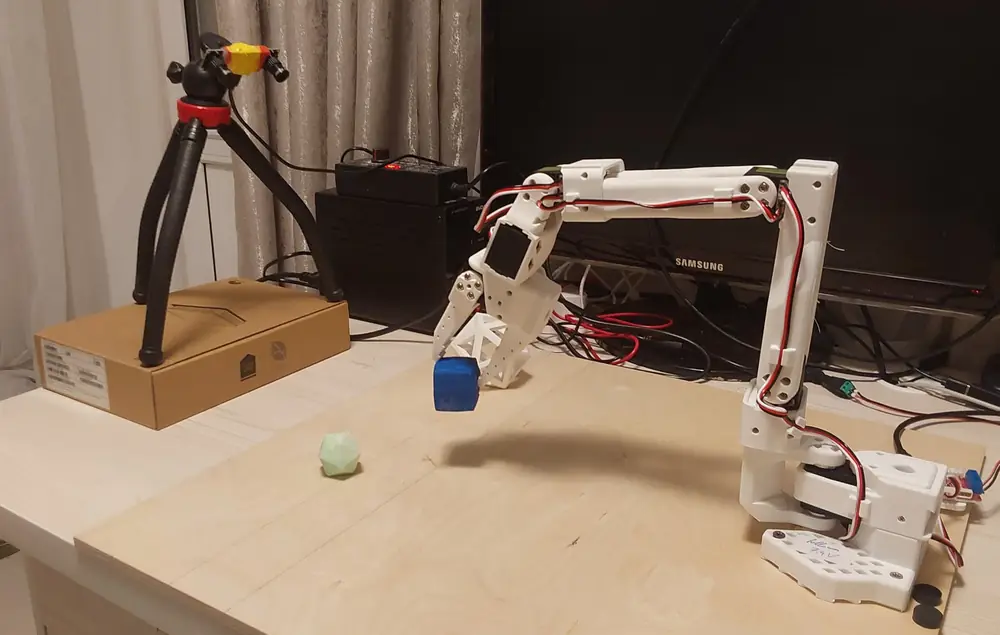
An everyday working setup: the SO-101 follower arm holding a test cube.
This blog documents my experiments in robotics and Physical AI, beginning with the LeRobot SO-101 manipulator. I am particularly interested in how modern AI methods can be applied to spatial and embodied tasks, and in what can realistically run on modest local hardware.
Research direction
The technical focus is on large language models (LLMs), vision-language-action (VLA) models, and agentic frameworks for spatial AI tasks. I want to explore multi-step scenarios, interaction with objects and environments, creative problem-solving, and adaptation when conditions or goals change.
Small models on local hardware
Computational resources are limited, so one recurring question is: what is the smallest model that can perform a useful task well enough? I will prioritize compact models that run efficiently on local hardware, with real-time or near-real-time operation wherever practical, rather than assuming that larger models are always necessary.
Reproducible experiments
Reproducibility is a core goal. I will document the hardware and software used in each experiment—including camera models, placement, and configuration—along with component setup, calibration, versions, settings, and step-by-step protocols. The aim is to make it possible to understand not only the result, but also how to reproduce the setup.
Simulation-to-real and generalization
Another central theme is transferring trajectories and behaviors developed in simulation to the physical SO-101, then studying where simulation and reality differ. I also want to evaluate how well models and methods handle unseen objects, configurations, and out-of-domain scenarios—not just familiar cases from their training or tuning environments.
-
Build and configure
3D printing, mechanical assembly, wiring, motor setup, and calibration.
-
Software and simulation
LeRobot tools, Python utilities, robot descriptions, and PyBullet experiments.
-
Lab notebook
Dated experiment reports: what was tried, what worked, what failed, and what comes next.
Working principles
- Reproducibility: record hardware versions, camera configurations, software versions, settings, and procedures.
- Measurement over assumption: distinguish measured results from estimates and hypotheses.
- Useful failures: preserve failed experiments and explain what they taught us.
- Resource awareness: evaluate capability alongside runtime, memory use, and compute requirements.